For a while this year, it looked like the electric 718 Boxster might never happen. In early 2026, reports suggested incoming Porsche CEO Michael Leiters was weighing a return to combustion power for the Boxster and Cayman. Instead, Porsche has doubled down — and the car now sits on the "home straight" toward production, with roughly four million kilometres of testing behind it.
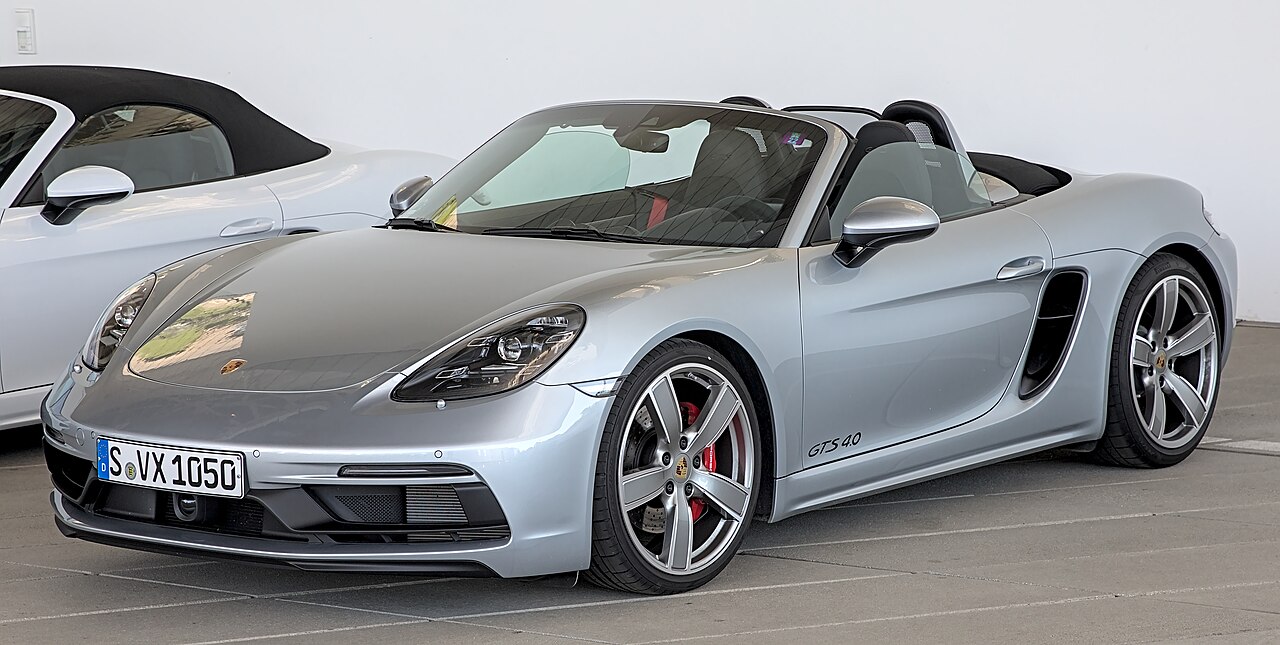
Image: Alexander Migl, Wikimedia Commons, CC BY-SA 4.0. The image shows the current combustion-engined 718 Boxster; Porsche has not yet revealed the electric car's final styling.

Why the electric Boxster matters
The Boxster has always been Porsche's entry point into mid-engined driving — lighter, more tactile, and more affordable than a 911. Electrifying it is a genuine test of whether the brand can carry its defining character into the battery era. The Taycan already proved Porsche can make a fast EV. The 718 Boxster EV has to prove it can make one that feels like a Porsche sports car, not just a quick electric coupe.
The stakes are real. Porsche has been navigating a sharp drop in China demand, tariff pressure in North America, and industrial upheaval in its home market. The Boxster EV is one of the most important products in its next-generation lineup — and the engineering team clearly isn't taking the easy route.
E-Core: a mid-engine battery
The most distinctive decision is the E-Core architecture. In most EVs, the battery is a flat slab under the floor, which raises the seating position and concentrates mass low in the chassis. Porsche flipped that logic for the 718. The 800-volt pack sits directly behind the seats, exactly where the flat-six used to live.
The result is a sports-car driving position — low, with the driver sitting deep in the car — and a weight distribution of 40 percent front, 60 percent rear, matching a traditional mid-engined car. Porsche says intelligent lightweight construction keeps overall weight similar to the current 911 Cabriolet with the T-Hybrid powertrain. It's a costly, bespoke solution, but it's the foundation the rest of the car's character is built on.
E-Shift: a gearbox that isn't there
Every 718 Boxster EV will come with E-Shift as standard. Press a button and a virtual seven-speed PDK transmission switches on, complete with paddles behind the steering wheel and a torque kick on each simulated shift. The sound is faithful to the 981-generation Boxster GTS's six-cylinder boxer engine. When E-Shift is off, the same paddles switch between three levels of brake regeneration.
Whether you love or roll your eyes at simulated gears in an EV, Porsche's reasoning is clear: single-speed electric driving can feel detached, and the company wants the 718 to engage its driver the way the old Boxster did. Two-time World Rally Champion Walter Röhrl, who has driven the prototype, called the car "sensational" and said it offers more feedback than any other electric car he's driven.
The most powerful 718 yet
Porsche confirms the electric Boxster will be the most powerful 718 in the model's history. The range-topping version sprints from standstill to 100 km/h in under three seconds and tops 250 km/h. All versions will be rear-wheel drive — a deliberate choice that keeps the car faithful to the Boxster's oversteer-friendly character.
The chassis leans heavily on 911 hardware. The steering is derived from the 911 Carrera GTS, rear-axle steering arrives on the Boxster for the first time, and the brakes, wheels, and tyres are 911-spec. An electronically controlled PTV+ limited-slip differential also comes straight from the 911 parts shelf.
Four million kilometres of proof
Porsche has been putting prototypes through the wringer across more than 20 countries. Testing ranged from -30°C ice and snow in Sweden to 51°C heat in Death Valley, with city evaluation in Las Vegas, Los Angeles, and Shanghai. Engineers validated charging across five different standards and ran routes from 86 metres below sea level to 2,750 metres up. All told, the fleet covered about four million test kilometres.
That's the kind of endurance work that tends to precede a car Porsche believes will be scrutinised hard. Given how much is riding on the 718's reception — and how loud the early skepticism was — Porsche appears determined not to leave obvious weaknesses on the table.
Bottom line
The electric 718 Boxster is shaping up to be the most interesting EV Porsche has made yet — not because it's the fastest, but because it's the one most explicitly designed to answer a single question: can an electric car still deliver the emotional, physical joy of a mid-engined sports car?
The E-Core battery and E-Shift gearbox are Porsche's answer, and they're refreshingly uncompromising. A low, mid-engined seating position, rear-wheel drive, and a virtual seven-speed gearbox are all choices a more cautious carmaker would skip. The full reveal is only a few months away — but for now, the electric Boxster no longer looks like a cancelled promise. It looks like the real thing.
Sources
- Porsche Newsroom — Development of first all-electric 718 Boxster reaches the home straight
- Top Gear — Porsche 718 Boxster electric review: reports of its death have been greatly exaggerated
- Porsche Newsroom — E-Shift explained: how Porsche is adding a new dimension to electric driving
- Porsche Press Database — Highly emotive driving experience: development of first all-electric 718 Boxster reaches the home stretch