For most of the robotaxi race, the companies grabbing headlines have been the ones already carrying paying customers. Nuro has been the quieter player — best known for its small, doorstop-shaped delivery pods rather than a four-door taxi. That profile is now changing. The company has just pulled the human from the driver's seat of a real passenger SUV, and it did so with two of the biggest names in mobility standing beside it.
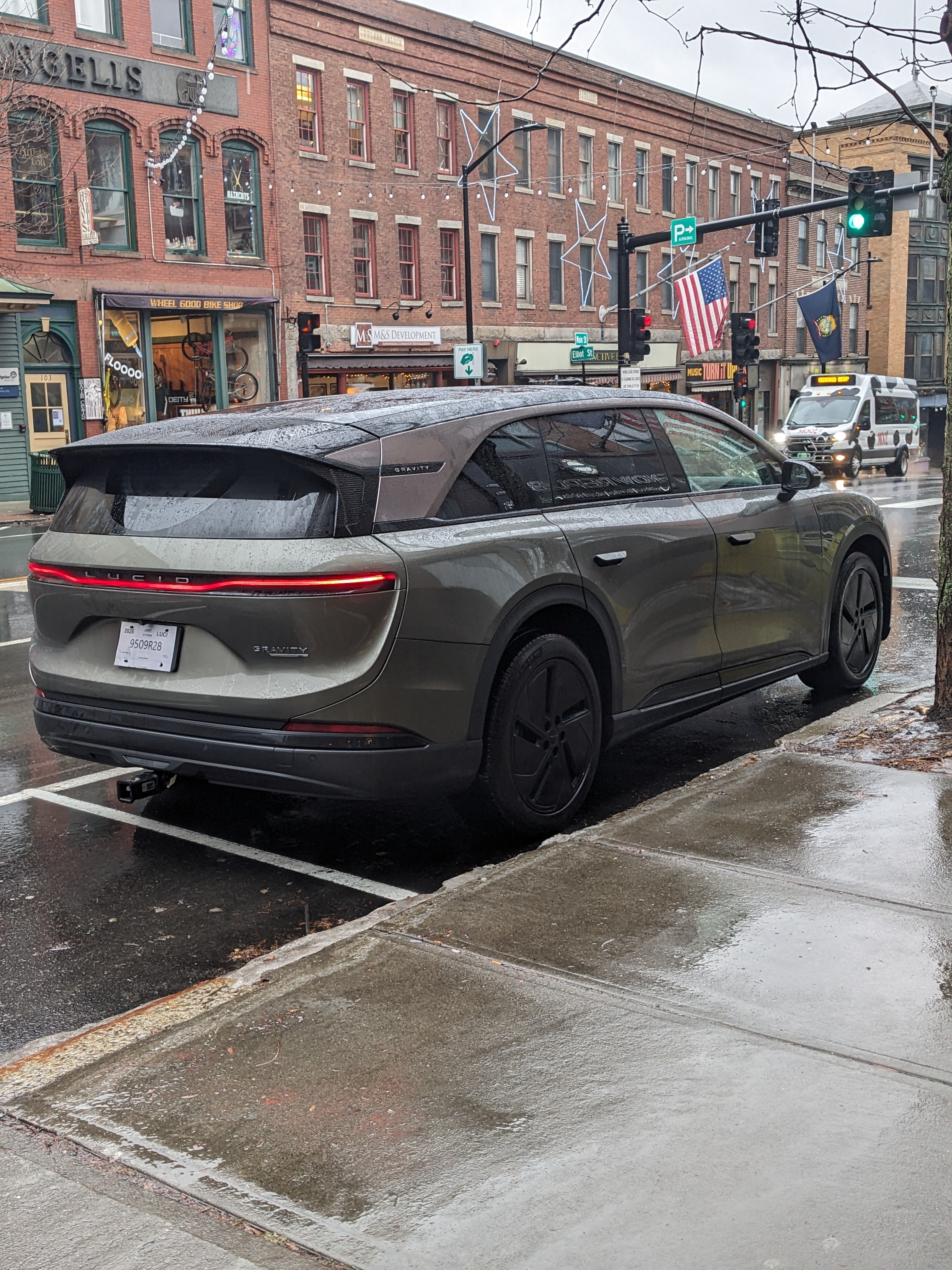
Image: Artaxerxes, Wikimedia Commons, CC BY 4.0.

What just happened
On Monday, November 24, the three companies announced that Lucid Gravity robotaxis equipped with the Nuro Driver have begun driverless testing on public roads in the San Francisco Bay Area. The phrase "driverless testing" matters here: until now, Nuro's Gravity fleet in the region always ran with a trained safety operator behind the wheel, ready to take over. That safety net is now gone for the test vehicles on these specific streets.
The initial footprint is deliberately contained. Testing covers four Peninsula and South Bay cities — Palo Alto, Mountain View, Los Altos, and Sunnyvale — with additional Bay Area cities planned for 2027. Nuro says Uber employees will "soon" be able to ride in the driverless vehicles, an internal step that typically precedes any public passenger service.
Driverless, but not launched yet
There's an important distinction between "driverless testing" and "driverless service." Nuro is doing the former. It is not yet selling rides to the public, and it is not yet running without a human on hand in any way at scale. What changed is that the vehicle itself can now operate on public roads with no one in the driver's seat — a regulatory and engineering milestone that's harder to reach than it sounds.
The groundwork for this moment was laid months ago. Nuro has run the Gravity robotaxis around the clock in the Bay Area and Houston since December 2025, but always with a safety driver. Before removing that driver, the company says it ran no-vehicle-operator testing at a closed course in Las Vegas, rehearsing the hard cases — pedestrian encounters, right-of-way violations, and other edge scenarios — alongside large-scale simulation.
Tilo Schwarz, Nuro's head of the Nuro Driver, was careful to point out that driverless operation "isn't new" for the company. That's fair. Nuro has run driverless delivery pods on California roads since 2020. But those pods are small, low-speed, and carry groceries — not people. This is the first time Nuro has taken the driver out of a full-size passenger vehicle, which is a very different safety case.
The permits, and a short list Tesla isn't on
The regulatory pieces were already in place before this announcement. In May 2026, the California DMV extended Nuro's driverless testing permit to the Lucid Gravity, and the California Public Utilities Commission followed with a permit for carrying passengers in a drivered pilot. That foundation is why Nuro could move from supervised to driverless testing without starting the permitting process from scratch.
Nuro is quick to note that it's one of just six companies allowed to test without a driver on California roads. The DMV's list, last updated in early November, confirms the club: AutoMo, Nuro, Tensor, Waymo, WeRide, and Zoox. Tesla is not on it. Tesla's "Robotaxi LLC" entity currently holds only a permit to test with a driver in California, and no deployment permit. It's a reminder that the regulatory bar for removing the driver is real, and not everyone has cleared it yet.
The timeline keeps sliding
When Lucid, Nuro, and Uber announced the program in July 2025, the plan was to launch a paid robotaxi service "later next year" in a major US city. As recently as mid-2026, when Uber named Houston as the second market for a mid-2027 launch, the Bay Area debut was still expected before the end of 2026. Now the public Bay Area launch has moved to the first quarter of 2027.
It's not a huge slip, but it is a slip — and in a field as competitive as robotaxis, timing matters. Meanwhile, the scale of the ambition has only grown. Uber's purchase commitment has climbed from 20,000 to at least 35,000 Lucid vehicles equipped with the Nuro Driver, starting with the Gravity and later extending to Lucid's upcoming midsize models. Uber will own and operate the cars with fleet partners, and they'll be available only through the Uber app.
For context, Lucid delivered 3,806 vehicles in the third quarter of 2026. At that pace, 35,000 robotaxis represents more than two years of the company's entire current output. The partnership is, in effect, a bet that robotaxis become a primary demand channel for Lucid's vehicles.
Why this matters for the robotaxi race
The most obvious takeaway is that the field is widening. Waymo remains the clear benchmark, already running a paid, fully driverless service across much of the Bay Area — including the same Peninsula and South Bay cities where Nuro is only now removing its safety drivers. Nuro and Uber aren't catching Waymo in 2027. But they are building a credible second path, backed by Uber's enormous rider demand and Lucid's purpose-built electric platform.
The second takeaway is about how you get to driverless. Nuro's sequence — permits first, a formal safety case, closed-course testing, then the removal of the driver — is the textbook, methodical route. In an industry where some companies talk up autonomy while still only holding a permit to test with a driver, that discipline stands out. It's less flashy than a keynote, but it's how the technology actually earns its place on public roads.
Bottom line
Nuro, Lucid, and Uber have crossed a real threshold: a full-size electric SUV driving on public Bay Area roads with no one behind the wheel. It's not a paid service yet, and it's still a long way from matching Waymo's scale. But it's the clearest signal so far that the robotaxi race won't be a one-horse show — and that the slow, methodical path to driverless is producing its own momentum.
The timeline has slipped to early 2027, and the real test is still ahead: turning a contained, driverless test program into a reliable paid service that riders actually trust. For now, the safety driver may be out of the car, but the grown-ups are very much still watching the road.
Sources
- Nuro — Nuro, Lucid, and Uber Begin Driverless Testing on Public Roads in the San Francisco Bay Area
- Business Wire — Nuro, Lucid, and Uber Begin Driverless Testing on Public Roads in the San Francisco Bay Area
- Electrek — Nuro pulls safety drivers from Lucid Gravity Uber robotaxis in Bay Area
- Unite.AI — Nuro Begins Driverless Lucid Gravity Robotaxi Tests in Bay Area